
The Space In Between
That strange place where the artist must find a home

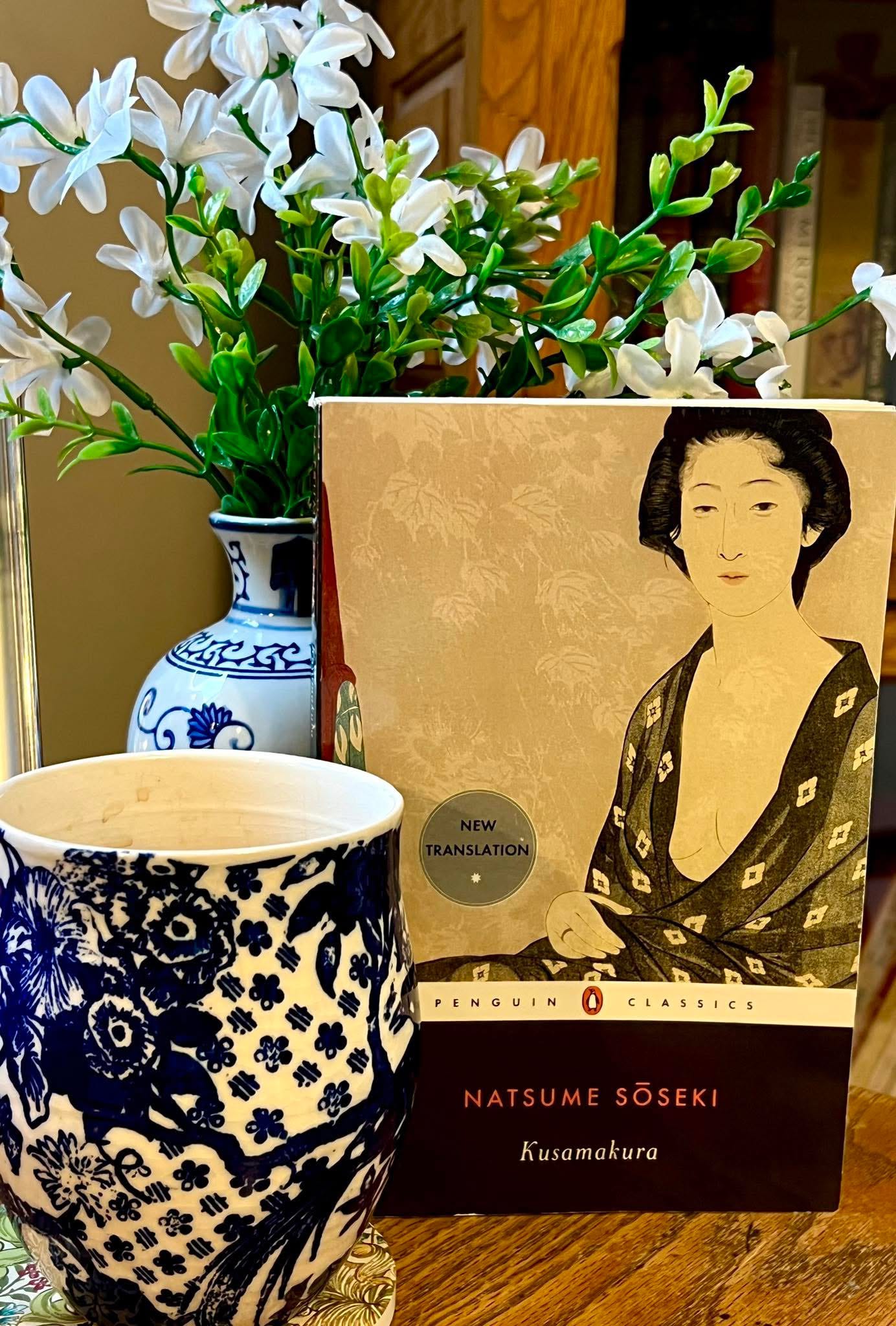
I finished reading this little book a few weeks back. I circled around it for a while and have finally concluded that it is a book that defies “containment”. The problem is, I love containment. I like nothing more than taking the lid off of a story and sorting through all the parts inside, then putting them back together like a puzzle as I read along. I always assume, sometimes incorrectly, that the author has the same intention as myself. Perhaps it comes from my impressionable years when I was taught to argue from principles to conclusions and it became my habit to approach everything in this way, including literature, which in the end you cannot always do. I am afraid old habits die hard. I still seek a reason for everything and everything for a reason in a storyline; a traditional beginning, middle, catharsis, and end. So, when I opened the cover to this little tale, I was ready to get to the point. Natsume Soseki was not. In fact, he was in great need of leaving the ‘point’ behind. He was escaping.
I came to this little story fortuitously, though I only know that now in hindsight. I was in the throes of navigating the aftermath of a toxic ‘friendship’ that I had, through my own fault, let go on too long because I had hoped it would become something other than what it was. It never did. It was messy with lies, competitiveness, envy, silent treatments, weird, emotional manipulations; but, then, also moments of real gentleness and seeming kindness and fellow feeling that reeled me in only to throw me back into the throes of second guessing myself and them once again. It was emotional chaos and I needed rest. I was exhausted. If you have been through this sort of thing in your life, you will know what I mean.
To be honest, I suppose I was trying to see something in this person that just wasn’t there. In this, alone, they were not at fault. I have a long history of hero worshiping too soon, alas. It is an innate, impatient, and pressing need for beauty I was born with, which sometimes makes me jump the gun for what I rashly take as a solid experience of deep fellow feeling, but which leaves me flailing in the emptiness of a reality that never really was. It is, as they say, my tragic flaw. If you have experienced this kind of thing, you will understand that the disillusionment that follows is always painful. To completely misread another person is always a humiliating experience when you realize in a kind of horror, that you have given them the deepest parts of your thought too soon. Such failed experiences leave one jaded, cynical, guarded and completely exhausted. That was the present struggle when I chanced to meet Natsume Soseki. I was surprised to find that he, too, was in his own place of disillusionment, albeit in the late 1800’s.
Until around 1868 Japan had succeeded in keeping itself isolated from an industrial Western influence, guarding its ancient ways and rhythms. Eventually, after a mighty struggle, they decided as a nation to submit to the pressure of western thought and western ways. The “Old Japan” serene and agrarian and controlled as it was, felt ‘violent upheavals’ of change as it struggled to transform itself to fit into the fast flowing modern world. Natsume hated it. Unlike many of his contemporaries who rushed to keep up with modern ways, he balked at the idea. As a child he was given a traditional education with a strong grounding in the Chinese and Japanese classics which he learned to love deeply. The poetry and the art of his country were greatly cherished by him. As he moved on to University, he delved even more deeply into the past literature of his people. He began to feel a struggle within his heart - a great love for this beautiful, controlled atmosphere of ancient Japan found in mists, mountains, water, simplicity, and the controlled passions mirrored in serene faces and bodies. All this in stark contrast to the garish, turbulent, machine-like noise and materialistic ambition being adopted by his contemporaries without any discrimination except a nebulous longing for ‘progress’.
Being one of his country’s promising young thinkers, Natsume spent time in England on a government sponsored scholarship that expected him to return with ideas for forming an understanding of Western Civilization and how to implement them in Japan. Natsume had to leave behind his wife and baby daughter for this two year odyssey abroad and was plagued with deep loneliness. He hated the literature of the west at that time, which was led by the ‘naturalism’ of the French writers and aimed at “a gritty realism and an emphasis on human entanglements.” It focused on man’s emotional struggles and relationships ever rife with an obsessive and merciless self examination, delving minutely into the darker side of human action. This constant focus on “humanness” depressed Natsume, who had steeped himself in the past - in the serenity of the ancient Japanese naturalism which prided itself on order, balance, self-control and simplicity; on love of nature and its gentle lessons. For a time, he tried to bring the two worlds together in his writing - trying to make a hybrid sort of literature. It made him lonelier. He was one of those souls that straddled the timeline of history in places that stretched people like himself far too thin. There were undoubtedly great emotional casualties from this time period in history.
When I met Natsume, however, he was writing this little memoir of an impromptu hike he was taking into the Japanese mountains. He was tired and in need of rest. Emotional rest. He was hoping to find his beloved ancient Japan in those mountains. He had brought along his box of paints and a journal for writing what he called bad poetry, but poetry nonetheless. For he was an artist. He ruminates on the artist’s role in the world. To see through the messiness of human action and the unrest it brings to the soul and to erase it from his art. To be one whose eye is drawn to scenes from life lived apart from mundane, human strife - still-life impressions of beauty captured almost like the shutter click of a camera - only with paints and words; striving to leave behind struggle and questioning and to only deal with the serene beauty of all we see. A purity distilled from a world rife with ugliness and unpredictability. He is determined on this little quest into the mountains, to be devoted specifically to this kind of artistry. He wants nothing to do with the “humanness” that plagues him in his usual, everyday dealings with the world; all the uncertainties and embarrassments of human interactions. He wishes to be a disinterested third party observer of life. Someone cooly looking in from the outside. Observing humans in only their best and most serene of moments; as part of nature - harmonious with it and not in any way anomalous. He calls this the ancient artist’s gift. To capture the best in us and leave behind the dross.
Needless to say, I was intrigued as to how this was going to work out for him and I tagged along quite willing to leave behind the emotional “humanness” I was experiencing at the present time. I, too, was in search of the refreshingly un-human at least for a time. He insists there is no story here. No beginning, middle or end. No catharsis. Just a little journey in quest of a world devoid of disruptive emotions; a journey through the mountains that stops at an Inn and takes in the scene.
He has lovely, picturesque descriptions at the outset. Of the terrain, of a skylark flying into the sun, of blazing yellow and pink blossoms, and blue skies. I was captivated by his writing. He also ruminates on the challenges of perhaps meeting other humans on the road and how a true, disinterested Japanese artist might deal with them. How to make them part of a painted scroll or a haiku with an aloof kind of skill. No emotions. No ugliness. Seeing them all perhaps moving through life, but not interacting with them as a complicated human might do.
It’s a strange and wonderful idea, this notion that an artist can almost stop time and and carefully extract a serene part of the world from the usual upheaval before him. He has eyes to see the fleeting moment when the magic happens. Yet, it’s not always a seamless process getting to that point.
The inevitable whimsy and humor that result from his own endeavors are quite funny; he is not above laughing at himself and his notions. He is doing quite well as he hikes along expounding on the picturesque beauty of nature, so glad to be free from human upheaval, until he is plagued by a sudden downpour of rain that leaves him soaked to the skin and experiencing the most unromantic, uncomfortable reality of wet underwear. Where is the poetry in that, he suddenly wonders? The world has almost shape-shifted into something altogether less pristine than what he had captured just moments before - including himself. Natsume discovers that you cannot quite be a disinterested observer in a world in whose story you are a character. The best you can do is be there as witness when the world shape-shifts from something utterly unearthly back into its mundane existence. Most people only see the mundane. Poets and artists dwell in the space where the ideal mysteriously reveals itself suddenly underneath the mundane. The poet must learn to live with and accept the mundane in order to find the mystery and be ready to pounce and capture it. The mundane and the mystery are always inextricably bound together in this world.
Natsume does at times succeed in his quest for this coveted, serene purity, however. He is captivated by the innkeeper’s daughter. He sees her from afar in her kimono and ornate hairstyle, serenely gazing at the mountains like an ethereal angel whose robes are gently swayed by the wind. She is deep in thought. He reaches tentatively for his paintbox. But, alas. She suddenly turns a certain way and he sees that her eyes are dancing with mischief or are laughing at him. That her hair’s widow’s peek is too pronounced and her mouth at times drawn into a frown that in no way fits into his serene little poetic image of her. He must lower his brush. He misses the moment. Reality always seems to intrude upon his little fantasy of artistic perfection. But you suddenly admire him for noticing and capturing both that serene inner princess and who also spontaneously transforms into a dissatisfied woman, who has lived a messy life and defies being part of a painted screen of any kind. His short, descriptive ‘capture’ of that angel nature hovering just underneath was worth the waiting for because in truth it also is a part of what makes the young woman who she is. He experiences the same sorts of things with a less than talented barber who shaves him far too closely and is far too garrulous to quietly recede into the background of anything remotely picturesque. There is a young Japanese monk who has allowed himself to fall in love with said girl placing in jeopardy all the artist’s preconceived notions of a here-to-fore serene, unperturbed monk-ti-tude. The monk does conquer himself in the end, but not as the artist might suppose it would happen. It is, well, as messy as real life. Another young monk has decided to go to war for his country, a decision from which questions arise about notions of peace and dutiful patriotism. In short, just when the artist settles down to capture the serene aspects of this old mountain life, he is confronted with the reality of the humanness he sought to escape. I found it so intriguing. Humans are always and ever a part of the landscape and they will not be flattened into a false serenity.
I do not do justice to his lyrical flights of fancy when he is surrounded only by natural beauty: a moon soaked evening, a warm bath, and the loveliness of hot tea and a book. His writing is magical. His humor has a beautiful and self deprecating finesse.
But my take away is this. The true artist lives constantly in the in between land. The place where everything is not to be contained but shifts and changes suddenly to your utter surprise. As an artist you are granted the privilege of seeing it. This necessitates that you be willing to suffer from the mundane humanness of the world. That you are willing to suffer from your own humanness, your ridiculous mistakes, your misconceptions of others and yourself. That sometimes bad things will happen and people will do horrible things to each other and maybe never beg for forgiveness, but you must learn to live in hope that those same people might turn around and become a beautiful revelation of God’s love in a sudden and surprising turn of events. And you will marvel where perhaps you were tempted to despair only moments before. We are ethereal-earth, we humans. So much is going on here. We cannot be painted into a one dimensional screen drawing. If you try to escape the mundane, difficult side of life, you will never be there when the Parnassian shift happens - that colorful blur suddenly sharply focused into something shining and gorgeously revealed for only an instant and then is gone. No matter how fleeting, you will be glad you were patient and were willing to bear with the inevitable deflations of spirit that got you here to the magical minute.
The artist must be vigilant, have a sense of humor about himself and others, be willing to suffer some difficult disillusionments, be willing to forgive the all too human faults of others, and to wait patiently for the great shape-shift happening in every thing that has been created. In short, an artist must love the way God loves. Forgive the way God forgives. See the beauty where no beauty seems to be. An artist must seek to be holy and it will only happen in this strange, ethereal space ensconced in a fallen world, hovering between heaven and earth; a space that exists in every created thing. There will not always be neat and tidy reasons for everything. Not always a beginning, middle and end. The catharsis might come at a time when you were least expecting it.
That is what I gleaned from this little book. You might see something entirely different. For, it is a story that defies containment. It, too, is a shape shifter. I was glad to have made the journey with Mr. Soseki. He has made me content to live comfortably in the In Between spaces.
I do not feel inclined at this time to have a paid substack. But if we were together in a cafe discussing all these thoughts, I would not be opposed to you buying me a cup of coffee - with cream, of course. In that spirit, if any of my posts resonate with you and you feel so inclined, you can donate here: buymeacoffee.com/denise_trull
It really is a beautiful book. I read a few years ago with my high school students and think I'll pull it out again this summer for our poetry time. Thank you for the reminder!
Lovely evocative essay.
Despite never having visited Japan, I nevertheless have always had this vision of it as a modern western place coexisting with the poetic aspects of a past which is totally alive at the same time. I wonder if you have ever watched the amazing film "Mishima," made by Paul Scrader, with awesome music of Philip Glass and equally awesome production design. Read about it first and see if it might appeal.